




















































How The Metaverse Will Impact Live Entertainment
25 August 2022
Written By:
In recent years, significant global events have tilted the events industry. The covid 19 pandemic implicated an unprecedented need for events to be experienced from home safety. Artists have pivoted at break-neck speed to be able to provide virtual acts and global clients have embraced virtual entertainment in ways never seen before.
We have also seen rocket speed evolution in social technology. There is now a majority number of viewers for esports over ‘real life’ athletics with over 4 million people viewing last year’s League of Legends finals, to take an example. Hardwired to smartphones and digital existence, humankind is a community that is hungrily advancing towards tech reliance.
Here enters—the metaverse. Answering the eternal call from clients for genuinely original live entertainment experiences, the metaverse is an exciting prospect. Still in its relative infancy, the metaverse offers immense potential for innovation and creativity. The face of live entertainment is changing—and with it, the future of events as we know them.
What is the metaverse?
Simply explained, the metaverse is the internet in 3D. It is an experience of digital interaction within a simulated space that replicates reality or imagines realms beyond it. Within the metaverse, you can be humanly present in ways that screens and video calling cannot match. Fundamentally it is not being ‘on’ the internet, it’s actually being 'in' it.
Wrongly assumed to belong to Facebook due to its ‘Meta’ company renaming in 2021, the term metaverse was first coined in the 80’s when Neil Stevenson proposed the notion in a novel. He wrote about a virtual realm where characters could escape totalitarian reality. Sega released its first VR arcade game in the 90’s leading to the term becoming colloquial.
In 1998 SportsVision broadcast the first NFL game featuring yellow card markers and the idea of graphics over video quickly spread across other channels. With the first VR headset invented in 2010—followed by Ray Ban’s ‘smart’ glasses and Ikea’s virtual design app—the flame of common interest was lit for what virtual reality might become.
With major music stars like Travis Scott and Snoop Dogg selling out audience tickets to their virtual reality concerts, the buzz around metaverse entertainment is spreading rapidly. Though Travis Scott's 2021 Fortnite gig was a fraction of the length of a normal concert at only 10 minutes, it was attended by a staggering 12 million avatar audience members.
Travis Scott's 2021 Virtual Reality Concert hosted by Fortnite (Image Credit: Epic Games)
What are the positives?
The potential of the metaverse for live entertainment is huge. There is scaleable opportunity to expand upon current event formats, such as hybrids where some of the guest experience is in reality and the rest intakes place in the virtual world. With digital technology developing rapidly, there are plenty of fresh ways of staging events using VR at live events, including innovative use of augmented reality entertainment.
The creative attraction for guests is as strong as it is for event companies. Within the metaverse it is possible to innovate avatars of ourselves. Guests can be whoever they wish to be within virtual reality, from the way they dress to their facial shape. The metaverse is an open space where guests can liberate themselves from any in-person lack of confidence or individual restriction.
Certain companies have already harnessed the power of the metaverse to launch original campaigns. This year USA chain Chipotle released a limited game on Roblox which allowed customers to earn ‘burrito bucks’ which could be exchanged for free food in real restaurants. This kind of hybrid event is set to be a major player in events of the future.

Chipotle's 'Build a Burrito' Virtual Event hosted by Roblox (Image Credit: Chipotle)
Beyond the artistic and commercial potential, the eco factor is also significant. Removing the need for flights for performers, equipment and staff will reduce event carbon footprint. This is an attractive sales point for many clients and event planners. Physical consumerism and product waste can also be minimised or entirely removed if guests can access virtual entertainment.
The up-sell potential within the metaverse is also enticing. Event visitors can be invited to purchase access to VIP areas within virtual reality and to purchase gifts for themselves or others also. The gaming feel to virtue reality realms can help to encourage event attendees to engage in ways they might not in reality, giving further opportunity for increased event profit.

Screen example of a virtual concert space (Image Credit: Flipside Group)
We are able to access the metaverse (and thus, virtual event experiences) on a number of devices that include VR goggles, 3D wall screens and even the common smartphone. This is hugely advantageous for events companies as it means that guests of all ages and locations can potentially access live entertainment as long as they create a platform user account.
The greatest benefit of the metaverse is the absence of physical limitation. In 2020, Travis Scott performed a live concert on a virtual island within the Fortnite platform to a record-breaking audience of 12 million participants. Audiences of that size are out of the question in reality and the aesthetics and individual participation also wouldn’t be possible.
What kind of live entertainment would work well in the metaverse?
This is where it all gets very exciting. The brilliance of the developing metaverse is the inspiring versatility of it. As entertainment specialists, we provide standout entertainment and unique acts to amaze and inspire event guests all over the globe. From here, it's a case of establishing how to transfer everything we have learned within the expanding realm of virtual entertainment.

Here's a shortlist of some of the potential live entertainment options:
Screen example of a virtual social space (Image Credit: Flipside Group)
Here's a shortlist of some of the potential live entertainment options:
Festivals
Large scale social events similar to Burning Man and Glastonbury can be virtually recreated in the metaverse featuring either live or prerecorded DJ sets played by avatars. It could also be possible to employ the latest technology entertainment acts and motion technology to produce real time show performances; performers in reality could be dancing live in the metaverse through the use of motion sensors affixed to their bodies.
Large scale social events similar to Burning Man and Glastonbury can be virtually recreated in the metaverse featuring either live or prerecorded DJ sets played by avatars. It could also be possible to employ the latest technology entertainment acts and motion technology to produce real time show performances; performers in reality could be dancing live in the metaverse through the use of motion sensors affixed to their bodies.
Art Installations
Guests can wander the halls of virtual galleries in the metaverse. It's possible to view and buy NFT (non-fungible tokens) versions of art pieces or link to a 'real' online store. From sculpture and portraits to independent film and contemporary circus, the possibilities are excitingly diverse. You can even hire a holographic assistant to create some artistic wow-factor!
Guests can wander the halls of virtual galleries in the metaverse. It's possible to view and buy NFT (non-fungible tokens) versions of art pieces or link to a 'real' online store. From sculpture and portraits to independent film and contemporary circus, the possibilities are excitingly diverse. You can even hire a holographic assistant to create some artistic wow-factor!
Group Games
Beyond typical gaming experiences, there are endless possibilities for classic team building and socialisation games such as, 'capture the flag'. Expertly crafted escape rooms also work brilliantly within the metaverse in much the same way they do in reality. Digital animation can offer guests the opportunity to experience out of this world event experiences with interactive exhibits and custom app games that feature augmented reality characters and entertainment acts.
Beyond typical gaming experiences, there are endless possibilities for classic team building and socialisation games such as, 'capture the flag'. Expertly crafted escape rooms also work brilliantly within the metaverse in much the same way they do in reality. Digital animation can offer guests the opportunity to experience out of this world event experiences with interactive exhibits and custom app games that feature augmented reality characters and entertainment acts.
Fashion Shows
From gravity free runways to immersive mall shows where avatar guests can try on outfits for themselves, fashion shows are inherently creative events with colourful metaverse potential. This type of event could make great use of interactive entertainment acts combined with motion sensor technology and live motion recording or a pre-recorded production could be imported to be viewed by avatar guests with video mapping screens and projection technology.
From gravity free runways to immersive mall shows where avatar guests can try on outfits for themselves, fashion shows are inherently creative events with colourful metaverse potential. This type of event could make great use of interactive entertainment acts combined with motion sensor technology and live motion recording or a pre-recorded production could be imported to be viewed by avatar guests with video mapping screens and projection technology.
Creative Exhibitions
For an explorative feel, it's possible to create contrasting rooms featuring live and pre-recorded streams of performance acts with immense potential for branding and product placement. Excitingly, it's possible to use custom QR codes to import elements (such as moving characters) from the metaverse into the real world to be viewed via a guest smartphone as a captivating example of augmented reality entertainment.
For an explorative feel, it's possible to create contrasting rooms featuring live and pre-recorded streams of performance acts with immense potential for branding and product placement. Excitingly, it's possible to use custom QR codes to import elements (such as moving characters) from the metaverse into the real world to be viewed via a guest smartphone as a captivating example of augmented reality entertainment.
The discussion of 'what, where and when' is ongoing regarding whether certain entertainment acts will work better than others in the virtual space. This is because the developing metaverse is a moving target. As entertainment specialists, we would only ever offer our clients what we know will match or surpass what we already successfully provide.
Are there any drawbacks to the metaverse?
From the perspective of the events industry, the enemies of swiftly drawing out the potential of the metaverse are time and expense. It is a costly and time-consuming process to develop a virtual space. It requires plenty of programming which relies on technical coding and plenty of digital skill to ensure experience quality.
There are also laws that apply to metaverse event guests which are set by experience platforms themselves. Roblox restricts ‘real’ products being sold within the metaverse. This applies with most platforms for data protection and safeguarding. Virtual items can be purchased but physical branded items to be received in the ‘real’ world cannot.
Most challenging? Our humanness. The physical joy felt from witnessing live performance cannot yet be matched in the metaverse. Undoubtedly attendees can be moved to tears and laughter without being in the same room as a performer in the same way cinema achieves its impact. To establish metaverse success, we must innovate a worthy equivalent.
It’s the subtle nuances of body language between guests. Or the thrill of an entertainer appearing on stage and the first notes of music being heard. It’s the physical sensation of shaking a person’s hand at a corporate event. If guests become desensitised—either from lack of physical connection or VR overuse—it could threaten event satisfaction.
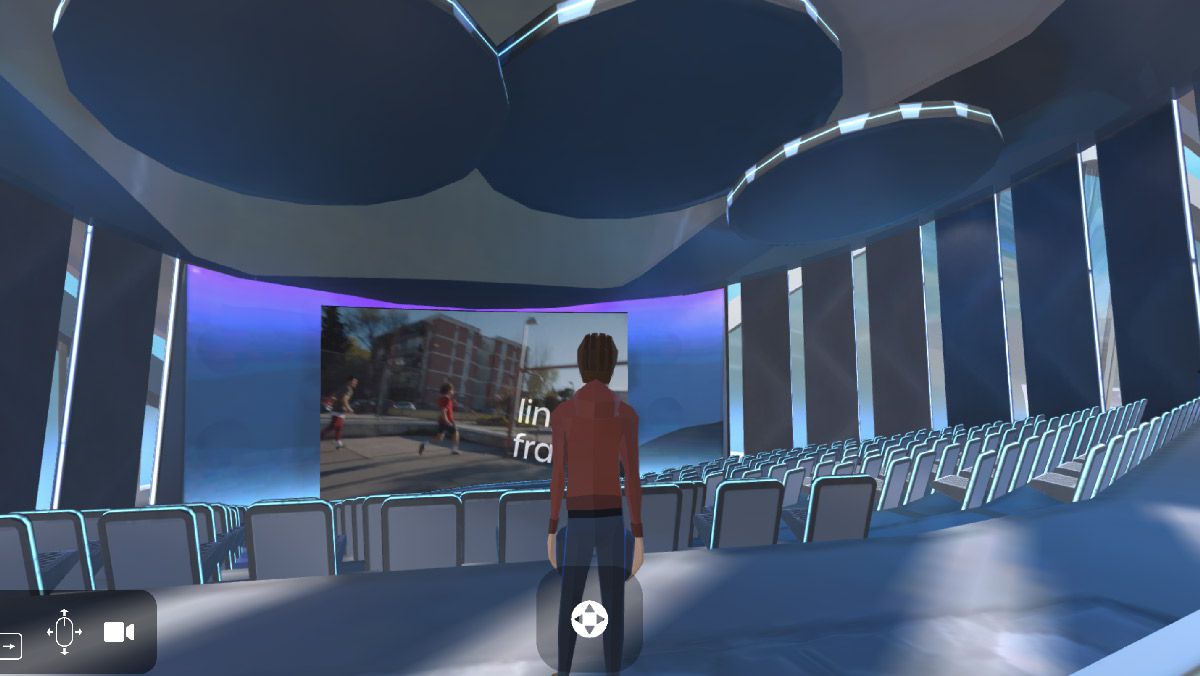
Screen example of a theatre with an imported live stream cinema (Image Credit: Flipside Group)
This is not to say that the metaverse cannot offer powerful entertainment experiences that inspire guests. We must not close our minds to the potential of the unknown. We could not have predicted how effective virtual entertainment would be until the pandemic catapulted the events industry into the arms of it. There’s a long way to go, but the potential is huge.
Genius and madness are muddled when we will only deem something worthy once it’s already proven its value. Every groundbreaking invention in history was doubted at some point by those refusing to consider the potential. We may not have all the answers to the metaverse yet, but do we need them to embrace the possibilities it offers?
Will the metaverse catch on?
It already has. When forced to remain at home during the worst of the global pandemic, we turned to virtual reality to find freedom. We streamed live shows, watched comedy within virtual audience rooms and stepped into virtual reality realms to play games and socialise online. We embraced digital entertainment in recognition of what it could offer us.
The metaverse may not yet provide the humanness we crave. It also cannot offer the quality of graphics we are used to nor provide an equally satisfying experience of entertainment compared to live shows. But can offer a fresh avenue of artistic innovation which could soon transform how we experience events and live entertainment.

The ‘.com’ boom was unprecedented and in many ways we just weren’t ready for it. We are still catching up with ourselves socially and economically with the world wide web we already have access to. There will certainly be many failures during the trial and error period of discovery of the metaverse. This is a natural part of any artistic or scientific enterprise.
The metaverse will never be in-person reality. Refreshingly, it actually isn’t trying to be. It offers us the next best thing to being in person within realms we cannot yet imagine. It is a digital bridge to out of this world events where we can see, hear and feel the atmosphere of live entertainment without travel. The metaverse has most definitely arrived. See you in there!
In recent years, significant global events have tilted the events industry. The covid 19 pandemic implicated an unprecedented need for events to be experienced from home safety. Artists have pivoted at break-neck speed to be able to provide virtual acts and global clients have embraced virtual entertainment in ways never seen before.
We have also seen rocket speed evolution in social technology. There is now a majority number of viewers for esports over ‘real life’ athletics with over 4 million people viewing last year’s League of Legends finals, to take an example. Hardwired to smartphones and digital existence, humankind is a community that is hungrily advancing towards tech reliance.
Here enters—the metaverse. Answering the eternal call from clients for genuinely original live entertainment experiences, the metaverse is an exciting prospect. Still in its relative infancy, the metaverse offers immense potential for innovation and creativity. The face of live entertainment is changing—and with it, the future of events as we know them.
What is the metaverse?
Simply explained, the metaverse is the internet in 3D. It is an experience of digital interaction within a simulated space that replicates reality or imagines realms beyond it. Within the metaverse, you can be humanly present in ways that screens and video calling cannot match. Fundamentally it is not being ‘on’ the internet, it’s actually being 'in' it.
Wrongly assumed to belong to Facebook due to its ‘Meta’ company renaming in 2021, the term metaverse was first coined in the 80’s when Neil Stevenson proposed the notion in a novel. He wrote about a virtual realm where characters could escape totalitarian reality. Sega released its first VR arcade game in the 90’s leading to the term becoming colloquial.
In 1998 SportsVision broadcast the first NFL game featuring yellow card markers and the idea of graphics over video quickly spread across other channels. With the first VR headset invented in 2010—followed by Ray Ban’s ‘smart’ glasses and Ikea’s virtual design app—the flame of common interest was lit for what virtual reality might become.
With major music stars like Travis Scott and Snoop Dogg selling out audience tickets to their virtual reality concerts, the buzz around metaverse entertainment is spreading rapidly. Though Travis Scott's 2021 Fortnite gig was a fraction of the length of a normal concert at only 10 minutes, it was attended by a staggering 12 million avatar audience members.
Travis Scott's 2021 Virtual Reality Concert hosted by Fortnite (Image Credit: Epic Games)
What are the positives?
The potential of the metaverse for live entertainment is huge. There is scaleable opportunity to expand upon current event formats, such as hybrids where some of the guest experience is in reality and the rest intakes place in the virtual world. With digital technology developing rapidly, there are plenty of fresh ways of staging events using VR at live events, including innovative use of augmented reality entertainment.
The creative attraction for guests is as strong as it is for event companies. Within the metaverse it is possible to innovate avatars of ourselves. Guests can be whoever they wish to be within virtual reality, from the way they dress to their facial shape. The metaverse is an open space where guests can liberate themselves from any in-person lack of confidence or individual restriction.
Certain companies have already harnessed the power of the metaverse to launch original campaigns. This year USA chain Chipotle released a limited game on Roblox which allowed customers to earn ‘burrito bucks’ which could be exchanged for free food in real restaurants. This kind of hybrid event is set to be a major player in events of the future.
Chipotle's 'Build a Burrito' Virtual Event hosted by Roblox (Image Credit: Chipotle)
Beyond the artistic and commercial potential, the eco factor is also significant. Removing the need for flights for performers, equipment and staff will reduce event carbon footprint. This is an attractive sales point for many clients and event planners. Physical consumerism and product waste can also be minimised or entirely removed if guests can access virtual entertainment.
The up-sell potential within the metaverse is also enticing. Event visitors can be invited to purchase access to VIP areas within virtual reality and to purchase gifts for themselves or others also. The gaming feel to virtue reality realms can help to encourage event attendees to engage in ways they might not in reality, giving further opportunity for increased event profit.
Screen example of a virtual concert space (Image Credit: Flipside Group)
We are able to access the metaverse (and thus, virtual event experiences) on a number of devices that include VR goggles, 3D wall screens and even the common smartphone. This is hugely advantageous for events companies as it means that guests of all ages and locations can potentially access live entertainment as long as they create a platform user account.
The greatest benefit of the metaverse is the absence of physical limitation. In 2020, Travis Scott performed a live concert on a virtual island within the Fortnite platform to a record-breaking audience of 12 million participants. Audiences of that size are out of the question in reality and the aesthetics and individual participation also wouldn’t be possible.
What kind of live entertainment would work well in the metaverse?
This is where it all gets very exciting. The brilliance of the developing metaverse is the inspiring versatility of it. As entertainment specialists, we provide standout entertainment and unique acts to amaze and inspire event guests all over the globe. From here, it's a case of establishing how to transfer everything we have learned within the expanding realm of virtual entertainment.
Here's a shortlist of some of the potential live entertainment options:
Screen example of a virtual social space (Image Credit: Flipside Group)
Here's a shortlist of some of the potential live entertainment options:
Festivals
Large scale social events similar to Burning Man and Glastonbury can be virtually recreated in the metaverse featuring either live or prerecorded DJ sets played by avatars. It could also be possible to employ the latest technology entertainment acts and motion technology to produce real time show performances; performers in reality could be dancing live in the metaverse through the use of motion sensors affixed to their bodies.
Large scale social events similar to Burning Man and Glastonbury can be virtually recreated in the metaverse featuring either live or prerecorded DJ sets played by avatars. It could also be possible to employ the latest technology entertainment acts and motion technology to produce real time show performances; performers in reality could be dancing live in the metaverse through the use of motion sensors affixed to their bodies.
Art Installations
Guests can wander the halls of virtual galleries in the metaverse. It's possible to view and buy NFT (non-fungible tokens) versions of art pieces or link to a 'real' online store. From sculpture and portraits to independent film and contemporary circus, the possibilities are excitingly diverse. You can even hire a holographic assistant to create some artistic wow-factor!
Guests can wander the halls of virtual galleries in the metaverse. It's possible to view and buy NFT (non-fungible tokens) versions of art pieces or link to a 'real' online store. From sculpture and portraits to independent film and contemporary circus, the possibilities are excitingly diverse. You can even hire a holographic assistant to create some artistic wow-factor!
Group Games
Beyond typical gaming experiences, there are endless possibilities for classic team building and socialisation games such as, 'capture the flag'. Expertly crafted escape rooms also work brilliantly within the metaverse in much the same way they do in reality. Digital animation can offer guests the opportunity to experience out of this world event experiences with interactive exhibits and custom app games that feature augmented reality characters and entertainment acts.
Beyond typical gaming experiences, there are endless possibilities for classic team building and socialisation games such as, 'capture the flag'. Expertly crafted escape rooms also work brilliantly within the metaverse in much the same way they do in reality. Digital animation can offer guests the opportunity to experience out of this world event experiences with interactive exhibits and custom app games that feature augmented reality characters and entertainment acts.
Fashion Shows
From gravity free runways to immersive mall shows where avatar guests can try on outfits for themselves, fashion shows are inherently creative events with colourful metaverse potential. This type of event could make great use of interactive entertainment acts combined with motion sensor technology and live motion recording or a pre-recorded production could be imported to be viewed by avatar guests with video mapping screens and projection technology.
From gravity free runways to immersive mall shows where avatar guests can try on outfits for themselves, fashion shows are inherently creative events with colourful metaverse potential. This type of event could make great use of interactive entertainment acts combined with motion sensor technology and live motion recording or a pre-recorded production could be imported to be viewed by avatar guests with video mapping screens and projection technology.
Creative Exhibitions
For an explorative feel, it's possible to create contrasting rooms featuring live and pre-recorded streams of performance acts with immense potential for branding and product placement. Excitingly, it's possible to use custom QR codes to import elements (such as moving characters) from the metaverse into the real world to be viewed via a guest smartphone as a captivating example of augmented reality entertainment.
For an explorative feel, it's possible to create contrasting rooms featuring live and pre-recorded streams of performance acts with immense potential for branding and product placement. Excitingly, it's possible to use custom QR codes to import elements (such as moving characters) from the metaverse into the real world to be viewed via a guest smartphone as a captivating example of augmented reality entertainment.
The discussion of 'what, where and when' is ongoing regarding whether certain entertainment acts will work better than others in the virtual space. This is because the developing metaverse is a moving target. As entertainment specialists, we would only ever offer our clients what we know will match or surpass what we already successfully provide.
Are there any drawbacks to the metaverse?
From the perspective of the events industry, the enemies of swiftly drawing out the potential of the metaverse are time and expense. It is a costly and time-consuming process to develop a virtual space. It requires plenty of programming which relies on technical coding and plenty of digital skill to ensure experience quality.
There are also laws that apply to metaverse event guests which are set by experience platforms themselves. Roblox restricts ‘real’ products being sold within the metaverse. This applies with most platforms for data protection and safeguarding. Virtual items can be purchased but physical branded items to be received in the ‘real’ world cannot.
Most challenging? Our humanness. The physical joy felt from witnessing live performance cannot yet be matched in the metaverse. Undoubtedly attendees can be moved to tears and laughter without being in the same room as a performer in the same way cinema achieves its impact. To establish metaverse success, we must innovate a worthy equivalent.
It’s the subtle nuances of body language between guests. Or the thrill of an entertainer appearing on stage and the first notes of music being heard. It’s the physical sensation of shaking a person’s hand at a corporate event. If guests become desensitised—either from lack of physical connection or VR overuse—it could threaten event satisfaction.
Screen example of a theatre with an imported live stream cinema (Image Credit: Flipside Group)
This is not to say that the metaverse cannot offer powerful entertainment experiences that inspire guests. We must not close our minds to the potential of the unknown. We could not have predicted how effective virtual entertainment would be until the pandemic catapulted the events industry into the arms of it. There’s a long way to go, but the potential is huge.
Genius and madness are muddled when we will only deem something worthy once it’s already proven its value. Every groundbreaking invention in history was doubted at some point by those refusing to consider the potential. We may not have all the answers to the metaverse yet, but do we need them to embrace the possibilities it offers?
Will the metaverse catch on?
It already has. When forced to remain at home during the worst of the global pandemic, we turned to virtual reality to find freedom. We streamed live shows, watched comedy within virtual audience rooms and stepped into virtual reality realms to play games and socialise online. We embraced digital entertainment in recognition of what it could offer us.
The metaverse may not yet provide the humanness we crave. It also cannot offer the quality of graphics we are used to nor provide an equally satisfying experience of entertainment compared to live shows. But can offer a fresh avenue of artistic innovation which could soon transform how we experience events and live entertainment.
The ‘.com’ boom was unprecedented and in many ways we just weren’t ready for it. We are still catching up with ourselves socially and economically with the world wide web we already have access to. There will certainly be many failures during the trial and error period of discovery of the metaverse. This is a natural part of any artistic or scientific enterprise.
The metaverse will never be in-person reality. Refreshingly, it actually isn’t trying to be. It offers us the next best thing to being in person within realms we cannot yet imagine. It is a digital bridge to out of this world events where we can see, hear and feel the atmosphere of live entertainment without travel. The metaverse has most definitely arrived. See you in there!
25 August 2022
Written By:
Latest Blog Articles